
In today's manufacturing industry, welding automation has become an essential technology for improving production efficiency, welding quality, and workplace safety. Robotic welding systems are widely used in industries such as automotive manufacturing, metal fabrication, machinery production, and structural steel manufacturing.
Among different welding technologies, MIG and MAG welding robots are two of the most commonly adopted solutions. Understanding the differences between MIG and MAG welding processes helps manufacturers select the right robotic welding system for their production needs.
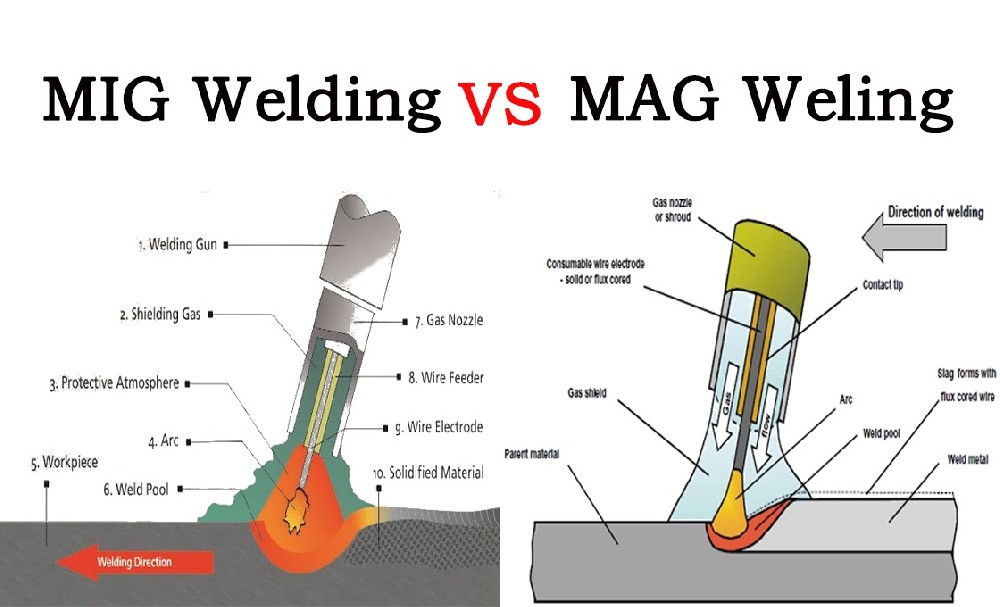
MIG (Metal Inert Gas) welding and MAG (Metal Active Gas) welding are both based on Gas Metal Arc Welding (GMAW) technology. Both processes use a continuously fed welding wire as the electrode, allowing welding robots to perform continuous and stable welding operations.
The main difference between MIG and MAG welding is the type of shielding gas used during the welding process.
MIG welding uses inert shielding gases, mainly argon or helium, which protect the weld pool from contamination without actively reacting with the welding process.
MIG welding robots are commonly used for applications requiring excellent weld appearance and high precision, including:
Aluminum welding
Stainless steel welding
Precision metal fabrication
Products with strict surface quality requirements
The advantages of MIG robotic welding include:
Excellent weld appearance
Low welding spatter
Stable arc performance
Suitable for thin and delicate materials
High welding accuracy
For manufacturers focusing on premium welding quality and precise manufacturing, MIG welding robots provide an ideal automated solution.
MAG welding uses active shielding gases, such as carbon dioxide or mixed gases containing CO₂. These gases improve welding penetration and increase productivity, making MAG welding highly suitable for industrial manufacturing.
MAG welding robots are widely used in:
Carbon steel fabrication
Heavy machinery manufacturing
Automotive components
Structural steel production
Large-scale metal processing
The advantages of MAG robotic welding include:
Higher welding speed
Strong penetration capability
High deposition efficiency
Cost-effective production
Excellent performance for thick materials
For factories requiring high production capacity and reliable welding performance, MAG welding robots are often the preferred choice.
The best welding robot solution depends on the material, production requirements, and application environment.
MIG welding robots are more suitable for applications requiring high-quality weld appearance, precision, and materials such as aluminum and stainless steel.
MAG welding robots are more suitable for high-efficiency industrial production, especially for carbon steel structures, heavy equipment, and large-scale manufacturing.
Before selecting a robotic welding system, manufacturers should consider:
Material type and thickness
Required welding quality
Production volume
Welding speed requirements
Robot working range
Automation integration requirements
Choosing the correct welding process ensures better production efficiency and long-term manufacturing benefits.
As an industrial robot manufacturer, MOKA Robot provides advanced robotic automation solutions designed to improve manufacturing efficiency and welding consistency.
MOKA welding robots are developed for various industrial applications, including metal fabrication, machinery manufacturing, automotive components, and general industrial production.
With advanced robotic control technology, MOKA Robot welding systems help manufacturers achieve:
Robotic welding systems maintain stable welding paths and accurate parameters, ensuring consistent weld quality during continuous production.
Automated welding robots can operate continuously with high repeatability, helping manufacturers reduce production time and improve overall productivity.
MOKA robotic welding solutions can be customized for different manufacturing environments, supporting various welding requirements and production processes.
With the increasing challenge of finding experienced welders, robotic welding systems provide manufacturers with a reliable solution to maintain stable production capacity.
As global manufacturing continues to move toward smart automation, welding robots are becoming an important part of modern production lines.
Whether manufacturers need MIG welding robots for precision applications or MAG welding robots for high-efficiency production, selecting the right robotic solution can significantly improve manufacturing performance.
MOKA Robot continues to develop intelligent welding automation technologies, helping companies achieve higher productivity, better quality, and more competitive manufacturing operations.
MOKA Robot is a professional industrial robot manufacturer specializing in robotic automation solutions. The company provides industrial robots, welding robots, SCARA robots, and collaborative robots for various industries worldwide.
Through continuous innovation and reliable automation technology, MOKA Robot helps manufacturers improve production efficiency and move toward intelligent manufacturing.
