
For small and medium-sized manufacturers, factory automation is no longer limited to large enterprises with extensive production budgets. As labor costs rise and manufacturers face increasing pressure to improve productivity, more small factories are looking for practical ways to introduce automation without making a large initial investment.
A low cost automation robot for small manufacturers can provide a practical starting point. Instead of automating an entire production line at once, manufacturers can introduce industrial robots into repetitive, labor-intensive processes and gradually expand automation based on production needs and return on investment.
MOKA Robot provides a broad range of industrial robot solutions designed for different manufacturing applications, including welding, loading and unloading, handling, assembly, stamping, palletizing, sorting, and other industrial processes.
Small manufacturers often face different automation challenges from large factories. Production volumes may be lower, product types may change frequently, and available floor space and investment budgets can be limited.
Traditional automation projects may require significant investment in equipment, integration, programming, and production-line modification. For smaller companies, this can make full-scale automation difficult to justify.
A low cost automation robot offers another approach.
Manufacturers can begin with one specific process where automation can create measurable benefits. For example, a robot can be introduced for machine loading and unloading, material handling, welding, palletizing, or repetitive assembly.
Once the first application proves its value, additional robotic processes can be added step by step.
Low cost does not simply mean choosing the cheapest robot available. For manufacturers, the overall automation investment should be evaluated through productivity, reliability, flexibility, maintenance, integration requirements, and long-term operating costs.
A practical automation robot should provide several advantages:
Small manufacturers need automation equipment that fits their production budget. Selecting a suitable robot model according to payload, working range, speed, and application requirements can help avoid unnecessary investment.
MOKA Robot offers multiple robot categories, including SCARA robots, desktop small six-axis robots, medium-payload six-axis robots, high-payload robots, welding robots, and collaborative robots.
This product range allows manufacturers to select a robot according to the actual requirements of a production process rather than investing in an oversized system.
Many manufacturing processes involve repetitive operations that require workers to perform the same movement for hours every day.
Typical examples include:
Machine loading and unloading
Material handling
Welding
Sorting
Assembly
Palletizing
Stamping
Packaging
Part transfer
Automating these tasks can help manufacturers reduce repetitive manual work while allowing employees to focus on more valuable production and quality-control activities.
Small manufacturers often produce different products or change production requirements more frequently than large mass-production factories.
Robot flexibility is therefore important.
A multi-purpose industrial robot can potentially be used for different applications with appropriate tooling, programming, and integration. MOKA Robot provides industrial robot products for applications across automotive parts, metal processing, building materials, 3C electronics, and general industry.
This flexibility can help manufacturers build automation systems that can adapt as production requirements change.
For a small manufacturer that has never used industrial robots, the best strategy is usually to start with a clearly defined production bottleneck.
For example, if workers spend many hours loading and unloading CNC machines, an automated loading and unloading application may be a suitable starting point.
If welding is the main labor-intensive process, a welding robot can be introduced to automate repetitive welding operations.
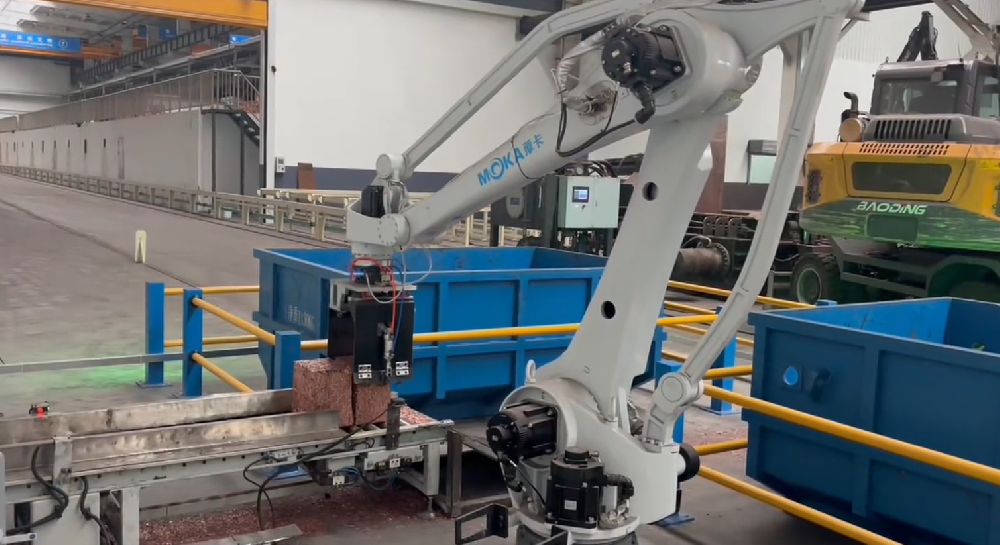
For factories handling large quantities of products, robotic handling and palletizing can also provide opportunities for automation.
MOKA's application cases cover various manufacturing scenarios, including automotive parts stamping, warehouse handling and palletizing, injection molding machine loading and unloading, metal processing, welding, and other industrial applications.
Labor availability has become an important consideration for manufacturers around the world. Repetitive and physically demanding jobs can be difficult to staff and retain workers for long periods.
A low cost automation robot for small manufacturers can help address this challenge by taking over repetitive operations while maintaining consistent production processes.
Robots can also operate continuously according to the designed production schedule, helping manufacturers make better use of available production hours.
The goal is not necessarily to replace every manual operation. Instead, targeted automation can be used to reduce labor pressure in specific processes where robots can deliver clear economic benefits.
One of the biggest advantages of starting with a cost-effective robot solution is scalability.
A small manufacturer does not necessarily need to automate an entire factory in one project.
A more practical approach may look like this:
Step 1: Identify the most repetitive or labor-intensive process.
Step 2: Select a robot based on payload, reach, speed, accuracy, and working environment.
Step 3: Integrate the robot with the necessary tooling and production equipment.
Step 4: Measure productivity, labor savings, quality, and operating costs.
Step 5: Expand automation to additional processes after the first application proves successful.
This gradual approach can make automation easier to manage financially and operationally.
Before purchasing an automation robot, small manufacturers should consider more than the initial equipment price.
Important factors include:
Robot payload and reach
Required cycle time
Robot repeatability
Application requirements
Available factory space
Integration with existing machines
Programming and operation
Maintenance requirements
Future expansion possibilities
Total cost of ownership
Choosing a robot that is properly matched to the application can be more cost-effective than simply selecting the lowest-priced equipment.
MOKA Robot focuses on developing and manufacturing industrial robot bodies for a wide range of manufacturing applications. Its product portfolio covers multiple robot types and payload levels, enabling manufacturers to select solutions according to different production requirements.
For small and medium-sized manufacturers, the combination of product variety, application flexibility, and cost-effective industrial robot technology can provide a practical path toward automation.
Whether the requirement involves welding, machine loading and unloading, handling, assembly, stamping, palletizing, or other repetitive industrial operations, the right robotic solution can help manufacturers improve production efficiency while controlling automation investment.
Factory automation does not have to begin with a large and complicated project.
For small manufacturers, starting with one high-value application can be a more practical way to evaluate the benefits of robotics, control investment risk, and build experience with automation.
A low cost automation robot for small manufacturers can serve as the first step toward a more efficient and flexible production environment.
MOKA Robot provides a range of industrial robot solutions for manufacturers looking to improve productivity, reduce repetitive manual work, and gradually introduce automation into their factories.
If you are evaluating automation for your production process, choosing the right robot for the specific application is the first step toward building a cost-effective automation solution.
