
Small and medium-sized manufacturers are increasingly looking for ways to improve production without making their factories more complicated. Frequent product changes, repetitive operations, limited production space, and pressure to maintain consistent output can all create challenges for manufacturing teams.
A low cost automation robot can provide a practical way to address these challenges. By introducing robotics into selected production operations, manufacturers can improve the consistency of repetitive tasks while maintaining greater flexibility in their production processes.
MOKA Robot provides industrial robot solutions for a wide range of manufacturing applications, helping companies integrate robotic technology into existing production environments.
Many manufacturing operations involve repeated movements that must be performed accurately throughout the working day.
Examples include transferring components, placing parts into machines, removing finished workpieces, positioning products, and moving materials between different production stations.
When these operations are performed manually, production efficiency can depend heavily on operator availability and consistency.
A robotic system can perform programmed movements repeatedly and maintain a stable working cycle. This allows manufacturers to use automation where repetitive operations create the greatest production challenge.
For a low cost automation robot for small manufacturers, the objective is to automate practical tasks without unnecessarily increasing the complexity of the production line.
Not every small factory has the same layout or manufacturing process. Some operate compact production areas, while others need to handle multiple product types.
Robot automation can be configured around different equipment and production stations according to the application.
MOKA Robot solutions can support processes such as:
Workpiece transfer
Machine tending
Component positioning
Material handling
Robotic welding
Assembly operations
Stamping-related part transfer
Finished-product handling
The specific robot configuration can be selected according to factors such as payload, reach, cycle requirements, workpiece characteristics, and available workspace.
Floor space can be an important consideration for smaller manufacturers. Adding large-scale equipment may not always be practical when production areas are already occupied by machines, worktables, conveyors, and storage areas.
A robotic workstation can be designed around an existing production process rather than requiring the entire factory layout to be rebuilt.
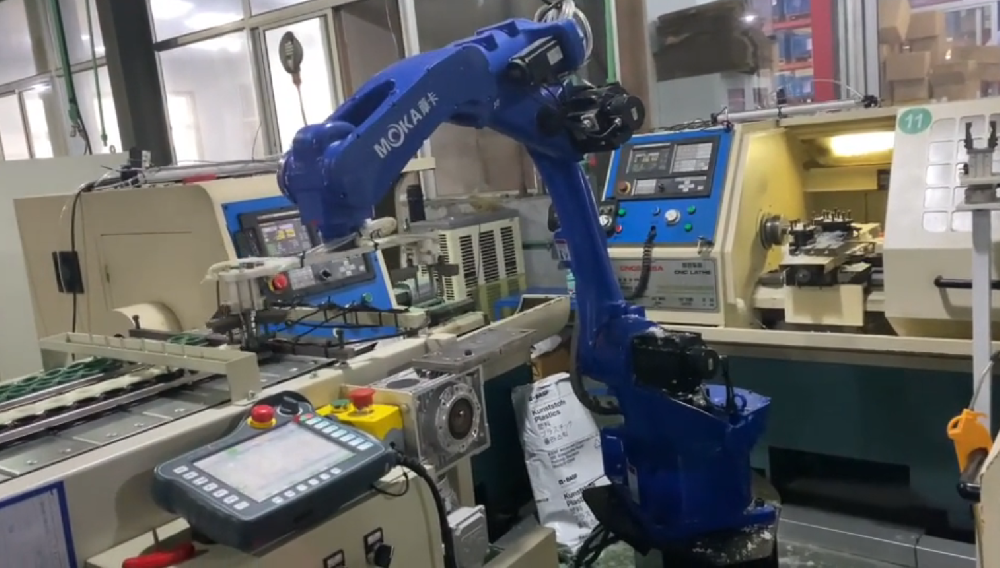
For example, an industrial robot can be positioned near a CNC machine to handle workpieces, or installed within a welding workstation to perform repetitive welding movements.
This makes robotic automation a potential option for manufacturers that want to improve a specific process while keeping their existing factory structure.
Small manufacturers often need to respond to customer orders with different product specifications. Production requirements can therefore change more frequently than in highly standardized mass-production environments.
Flexible robot programming and suitable end-of-arm tooling can allow robotic equipment to handle different workpieces or production sequences where the application permits.
This is particularly relevant for manufacturers producing metal components, automotive parts, fabricated products, and other products that involve repetitive handling or processing operations.
Instead of designing automation around only one fixed task, manufacturers can evaluate whether a robotic system can support several related operations.
MOKA Robot develops industrial robot products for different manufacturing environments. Its solutions cover applications including handling, welding, machine loading and unloading, assembly, stamping, palletizing, and other industrial processes.
The company's robot portfolio includes different robot configurations and payload levels, allowing manufacturers to select equipment according to their application requirements.
For small manufacturing businesses, this flexibility can be useful when production conditions vary from one factory to another.
Manufacturing requirements can change as a business develops. A factory may initially need to automate one handling operation and later identify additional opportunities around machining, welding, assembly, or product transfer.
Robotic equipment can provide a foundation for expanding automation when additional applications become suitable.
This creates a more flexible approach to manufacturing improvement, allowing companies to focus on practical production requirements rather than adopting a one-size-fits-all automation system.
The increasing availability of cost-effective robotic technology is giving smaller manufacturers more opportunities to modernize their production processes.
A low cost automation robot for small manufacturers can be used to address repetitive work, improve material flow, and create more consistent production operations while working within the physical and operational conditions of a smaller factory.
MOKA Robot continues to provide industrial robot solutions for manufacturers seeking practical and flexible ways to introduce robotics into their production environments.
For manufacturers exploring low cost automation robot solutions, MOKA Robot can provide industrial robotic options based on specific production applications and factory requirements.
