
Industrial automation is becoming increasingly important for manufacturers looking to improve productivity, maintain consistent quality, and reduce repetitive manual work. However, for companies that have limited experience with robotics, the complexity of robot programming and operation can sometimes become a barrier to automation.
MOKA Robot provides industrial robot solutions for manufacturers across different production applications, including handling, loading and unloading, welding, assembly, and other automated processes. By focusing on practical industrial applications, MOKA Robot helps manufacturers make the transition from manual production to robotic automation more manageable.
For companies introducing robots for the first time, an easy programming robot can make it easier for operators to learn basic robot operation, adjust production tasks, and manage routine automation requirements.
Robot programming does not only affect automation engineers. In many factories, production operators may also need to interact with robots during daily manufacturing operations.
They may need to adjust robot positions, change workpiece parameters, modify production sequences, or create programs for similar products.
An easy programming robot for factory automation beginners can help reduce the learning barrier by making routine robot operation more accessible to production personnel.
This can provide manufacturers with several practical benefits:
Easier training for new robot operators
Faster understanding of basic robot operation
More convenient adjustment of production tasks
Reduced dependence on highly specialized programming for routine changes
Greater flexibility when switching between similar products
A smoother transition from manual work to automated production
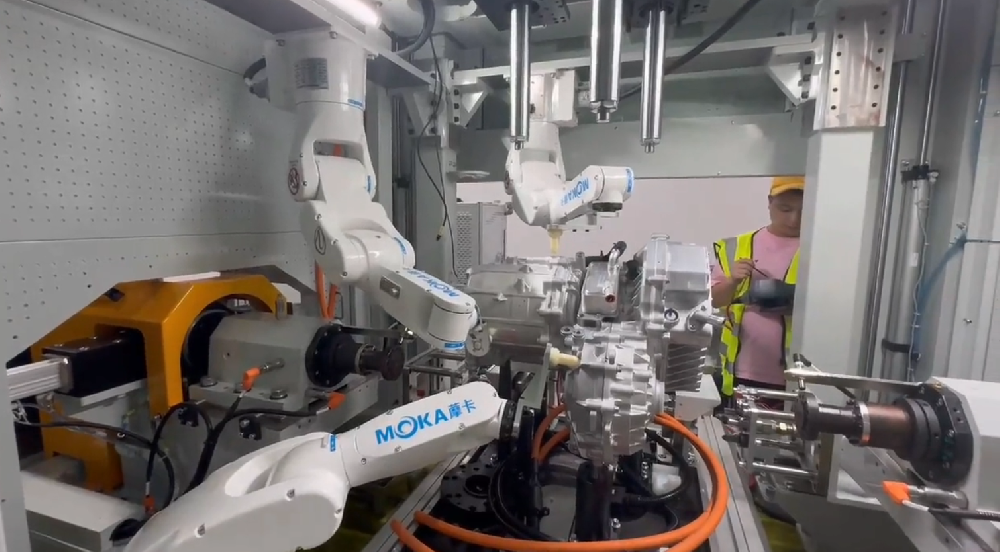
MOKA industrial robots can be applied to a wide range of manufacturing processes. Depending on the production requirements, robots can perform repetitive operations while operators manage production parameters and robot programs.
Industrial robots can automatically load and unload workpieces from CNC machines and other production equipment. This helps reduce repetitive manual handling while maintaining a consistent production cycle.
Robots can transfer components between machines, conveyors, fixtures, and workstations. Once the required movement sequence is configured, the robot can repeatedly perform the same handling operation.
Robotic welding can help manufacturers achieve consistent robot movement during repetitive welding operations. When production requirements change, operators may need to adjust robot positions or production programs.
Robots can perform repetitive component handling and assembly tasks, helping manufacturers establish stable production workflows.
Robots can also be used to transfer workpieces before and after stamping or other processing operations, reducing repetitive manual work on the production line.
Manufacturing environments often change. Different workpieces may require different robot positions, movement paths, or production sequences.
For factories with multiple products, the ability to manage robot programs efficiently can be particularly valuable.
An easy programming robot can help operators make routine adjustments without making every small production change dependent on external technical support.
This can be especially useful for small and medium-sized manufacturers where the same team may be responsible for both production and equipment operation.
For manufacturers new to robotics, automation does not need to begin with a highly complex production system.
A factory can start by automating one repetitive process, such as machine loading and unloading or material handling. Once operators become familiar with robot operation, additional applications can be introduced.
This gradual approach allows companies to build internal automation experience while improving production efficiency step by step.
An easy programming robot for factory automation beginners can therefore serve as a practical entry point for manufacturers starting their robotics journey.
Modern factories need to respond quickly to changing production requirements. As product varieties increase and production batches become more flexible, manufacturers need automation systems that can be adapted to different tasks.
MOKA Robot provides industrial robot solutions for different manufacturing applications, helping customers select suitable robotic systems based on payload, working range, production requirements, and application conditions.
From handling and loading and unloading to welding and assembly, robotic automation can help manufacturers create more consistent and flexible production processes.
Successful factory automation requires more than installing a robot. Manufacturers also need production personnel who can understand, operate, and manage robotic equipment effectively.
By lowering the programming and operation barrier, an easy-to-use industrial robot can help factories develop their automation capabilities and make better use of robotic equipment.
MOKA Robot continues to provide industrial robot solutions designed for practical manufacturing applications, helping manufacturers improve efficiency and take the next step toward intelligent production.
Looking for an easy programming robot for factory automation beginners? Contact MOKA Robot to discuss a practical robotic solution for your production needs.
