

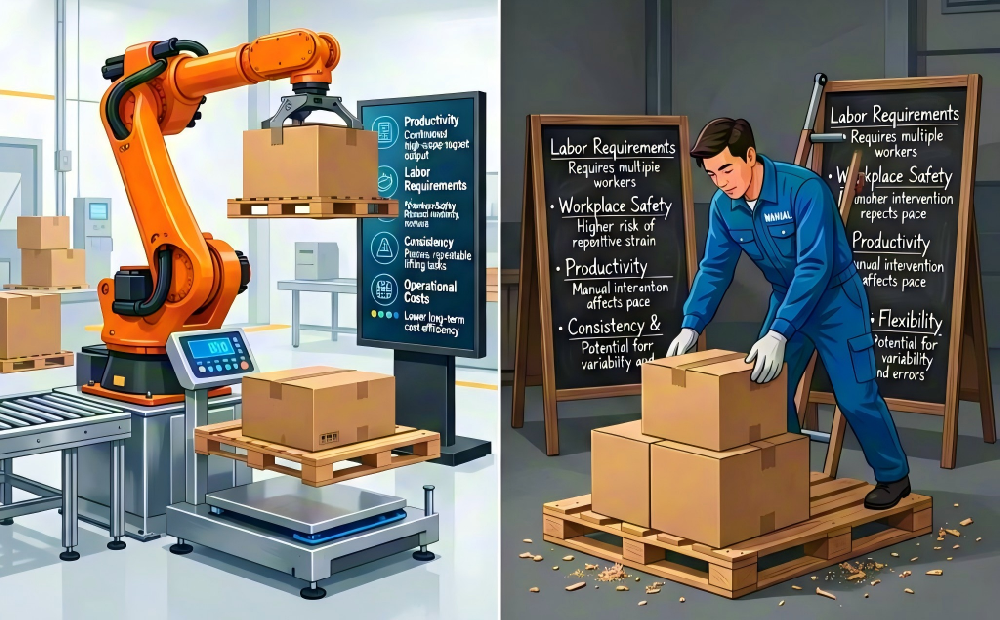
One of the biggest differences between automatic and manual palletizing is productivity. Robotic palletizing systems can operate continuously with consistent cycle times, allowing manufacturers to increase throughput and meet demanding production schedules. Unlike human workers, robots do not experience fatigue, ensuring stable performance throughout multiple shifts.
Manual palletizing, on the other hand, is limited by physical labor capacity and can be affected by fatigue, breaks, shift changes, and workforce availability.
Manual palletizing requires a significant number of workers to lift, move, and stack products throughout the day. As labor shortages continue to impact manufacturers globally, finding and retaining qualified workers has become increasingly difficult.
Automated palletizing systems reduce dependency on manual labor by allowing a single robotic cell to perform repetitive palletizing tasks efficiently and consistently.
Palletizing is physically demanding work that often involves repetitive lifting, bending, and twisting. These movements can increase the risk of workplace injuries and musculoskeletal disorders.
By automating palletizing operations, manufacturers can remove employees from hazardous and repetitive tasks, creating a safer working environment while reducing injury-related costs and downtime.
Manual stacking can lead to uneven pallet loads, inconsistent patterns, and product damage during transportation. Human error may also affect pallet stability, particularly during long shifts.
Automatic palletizing systems ensure every pallet is built according to predefined patterns with precise positioning and repeatable accuracy. This consistency improves load stability and helps protect products throughout the supply chain.
Although manual palletizing may require a lower initial investment, ongoing labor expenses can significantly increase operating costs over time.
Automated palletizing systems typically provide long-term savings through reduced labor requirements, higher productivity, lower product damage rates, and improved operational efficiency. Many manufacturers achieve a strong return on investment within a relatively short period after implementation.
Modern robotic palletizing solutions are highly adaptable and can accommodate various product sizes, packaging types, and pallet configurations through software adjustments.
As production volumes increase, automated systems can scale more efficiently than manual operations, allowing manufacturers to expand capacity without proportionally increasing labor costs.
For companies pursuing smart manufacturing and Industry 4.0 initiatives, automated palletizing provides a strategic advantage. It enables greater efficiency, predictable performance, improved safety, and better resource utilization.
While manual palletizing may still be suitable for very small operations, automated palletizing offers the long-term scalability and competitiveness required by modern manufacturing and logistics environments.
